Corleone Family
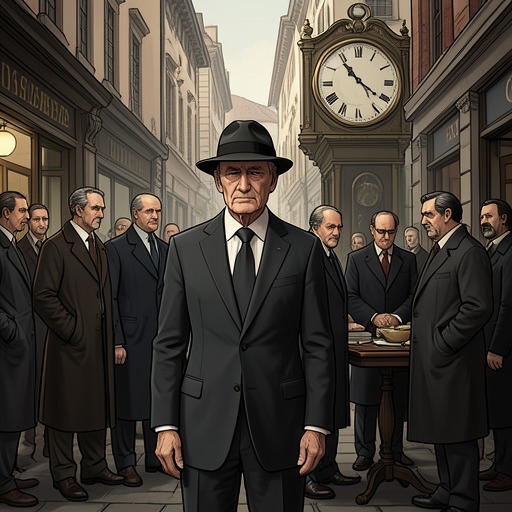
The GodfatherThe Corleone Family is the central institution of power in the novel: a private order that answers requests for justice, organizes labor and commerce, influences police and politics, conducts war, and protects its members while demanding loyalty in return. Its authority rests on a deliberately blended system. Vito Corleone presents himself as a generous patron and trusted friend, yet the organization also depends on secrecy, compartmentalized orders, armed enforcement, and the credible threat of disappearance. The result is neither merely a criminal gang nor a conventional family business, but a social and political system that competes with the official institutions of the United States.
Origins and Patronage
The Family's public face is established through Vito Corleone's relationship with supplicants. Amerigo Bonasera spends years trusting American law and order, but after the legal system fails to satisfy his demand for justice, hatred and fantasies of buying a gun give way to a decision to kneel before Vito Corleone. This movement from faith in the state to dependence on the Don defines the Family's political foundation: it becomes powerful where formal authority appears unable or unwilling to act.
Vito's clients do not need to be close friends, wealthy, or capable of repayment. They must proclaim friendship, after which he takes their troubles to heart and pursues a solution without accepting the excuse that stronger forces have tied his hands. The reward is not presented as a commercial fee. It is friendship, the respectful title of Don or Godfather, and an understood debt that may later be redeemed through a small service. Homemade wine, peppered taralles, and other modest gifts function as visible acknowledgments of obligation, turning gratitude into a durable social bond.
The organization therefore grows through reciprocity as much as through intimidation. Vito protects Italian families running small speakeasies, gives a confirmation gift to Mrs. Colombo's son, and establishes police and judicial contacts through a capable lawyer. Officials are placed on a monthly payoff sheet, but Vito insists that even officials who cannot immediately help should be included because friendship must be shown first. The network extends beyond underworld commerce into employment, bail, housing disputes, political advice, and assistance for poor neighborhood residents seeking relief or work. People in turn consult him about candidates for local, state, and national office, while young men from poor Italian families receive educational help and later become lawyers, assistant district attorneys, and judges.
Structure and Methods
As the organization expands, Vito converts personal influence into an insulated hierarchy. Clemenza and Tessio become caporegimes, the men beneath them become soldiers, and Genco Abbandando becomes Consigliere. Tessio's group is assigned responsibility for Brooklyn, while Clemenza retains operations in the Bronx under closer supervision. Vito deliberately limits social contact between the two caporegimes, not from personal hostility but to prevent them from combining against him. Territorial authority is granted, yet the possibility of conspiracy is structurally reduced.
The chain of command protects both the Don and the institution. When Vito orders action against the two young men who beat Amerigo Bonasera's daughter, he speaks privately to Tom Hagen. Hagen instructs Clemenza, Clemenza tells Paulie Gatto, and Paulie Gatto gathers the men who will carry out the order without knowing its origin or its purpose. Each layer is a buffer. Only a series of betrayals could connect the final operators to Vito, and the organization already possesses a brutal remedy for such exposure: one link in the chain need only disappear.
Tom Hagen's appointment as Consigliere demonstrates both the Family's personal trust and its departure from tradition. The position had normally been reserved for a full-blooded Sicilian shaped by Omertà, the law of silence, but Vito chooses Hagen because Hagen was raised within the family and can serve as counselor, right-hand man, auxiliary brain, and closest companion. The Consigliere knows nearly all the Don knows, drives him on important journeys, attends conferences, manages communications, and stands close enough to power to bring the entire structure down if he betrays it. In return, loyalty promises wealth, influence, respect, and protection for a Consigliere's wife and children even if he is imprisoned or dead.
The same organization uses relationships across institutional boundaries. To obtain Jack Woltz's attention, Hagen employs Billy Goff, the most powerful figure in the movie labor unions, and has him hint that failure to satisfy Hagen could bring a studio labor strike. The Family's formal empire may not extend beyond New York, but Vito's earlier assistance to labor leaders has created debts that travel across the country. A bank president makes a private conference room available for the Families' peace meeting because he is indebted to Vito; although Vito rejects the offer of a written document proving his ownership of the president's shares, he keeps private records so his heirs will understand the trust. Personal honor and hidden documentation coexist inside the same system.
Expansion, War, and Political Power
The repeal of Prohibition threatens the empire's earlier foundations, but Vito anticipates the change and seeks an equal partnership with Salvatore Maranzano, whose operations include gambling, shylocking, bookmaking, illicit poker houses, and Harlem's numbers racket. Vito offers organization, police contacts, and political protection in exchange for expansion into Brooklyn and the Bronx. When the wider underworld refuses cooperation, the Family's survival depends on its ability to convert influence into a larger territorial and commercial system.
Vito also treats peace as an instrument of power. He travels among underworld leaders in Los Angeles, San Francisco, Cleveland, Chicago, Philadelphia, Miami, and Boston, creating an agreement that preserves each organization's internal authority while regulating spheres of influence and enforcing peace. By the outbreak of World War II, the arrangement leaves the underworld comparatively stable while the official world enters global conflict. The Corleone Family profits from black-market food and gasoline stamps, travel priorities, war contracts, and scarce clothing materials, and it uses doctors or protected war-industry positions to keep eligible members out of military service. Michael Corleone's decision to volunteer for the United States military, however, reveals that the Don's authority does not fully control the loyalties of the younger generation.
The Family's claim to govern its own world is stated most directly at the peace conference. Vito argues that the Families must manage their own affairs rather than submit to outsiders who make laws for interests harmful to them. He renounces vengeance for his dead son and promises that, while he remains responsible for the Family, no one present will be attacked without just cause and extreme provocation. The pledge is political as well as personal: he sacrifices immediate commercial interests to preserve collective order, while openly reserving the right to arrange Michael's safe return from exile and false charges.
That peace follows catastrophe rather than preventing it. After the murder of Virgil Sollozzo and Captain McCluskey, police stations across New York City suspend gambling, prostitution, and other unlawful business, while raids halt the Family's operations. When the Corleone Family refuses to surrender the murderer, a bomb is thrown from a car at the Long Beach mall and two of its button men are killed while eating in Greenwich Village. The Five Families War begins, and later fighting proves costly to both sides. Police pressure particularly damages the Corleone Family's numbers operations: runners are arrested, banks are raided, and Harlem's territory is handed to scattered local operators who are harder to trace.
Succession and Reorganization
The organization is not automatically hereditary. When Vito announces semi-retirement and Michael's takeover, Clemenza and Tessio face the fact that powerful caporegimes in another Family might have inherited leadership or separated to form independent Families. The transition is therefore a constitutional crisis inside a nominally familial institution. It is made more dangerous by the Family's weakened position after the peace settlement: the Barzini Family, allied with the Tattaglia Family, becomes dominant in New York and begins taking over Corleone gambling territory and installing its own bookmakers.
Vito continues to recognize talent within the changing structure. After the peace meeting, he tells Hagen to watch Rocco Lampone, whom he sees as worth more than his quiet, perfectly correct performance as bodyguard and chauffeur suggests. The remark shows the Don's continuing ability to read latent capability, but it also points toward a system in which advancement depends on observation and judgment rather than simple birth or rank.
Under Michael, the Family adopts a long-term western strategy. The plan is to move its base toward Las Vegas, sell its olive-oil interests, and build from a substantial interest in a hotel and casino. The change is gradual, expected to take two, three, or even four years, and is described as the future of the Family rather than an immediate flight. Its commercial direction shifts from the older New York network toward casinos, hotels, and a more concentrated form of ownership.
The final reorganization confirms Michael's victory. After a year of political maneuvering, he becomes the most powerful Family chief in the United States, dividing his time between the Long Beach mall and Las Vegas before closing the New York operation. The Corleone Family becomes unchallengeable; Clemenza has his own Family, Rocco Lampone serves as Corleone caporegime, Albert Neri heads security for the Family-controlled hotels in Nevada, and Tom Hagen remains part of Michael's western organization. The old headquarters, houses, and mall property are sold, turning the end of the New York era into an administrative and commercial transaction rather than a simple disappearance.
Significance
The Corleone Family's distinctive power lies in its ability to make coercion feel like obligation and private loyalty function like public administration. It offers protection, charity, employment, political guidance, legal access, and revenge, but each benefit also enlarges the recipient's debt. Its violence is most effective when hidden behind layers of intermediaries; its legitimacy is strongest when people approach it voluntarily after official institutions have failed them.
The organization also embodies a historical contradiction. Vito imagines that the old world of guns, killings, and massacres should yield to business, prosperity, and better lives for children and grandchildren, yet the Family's rise depends on the very violence and secrecy that it claims to outgrow. Michael's move to Las Vegas does not abolish the structure; it relocates, centralizes, and professionalizes it. The final form is less visibly rooted in neighborhood supplication than Vito's regime, but it remains built on inherited debts, disciplined force, and the capacity to make an offer that others cannot refuse.